


A Township Tale: Fun Premise, Bad Tutorials
A Township Tale is a new VR title from Alta, which just released on Oculus Quest. It has best been described as a sort of Runescape VR (for anyone who still plays or remembers that most venerable of graphical MUDS). While lacking in the “Massive Multiplayer” aspect of a game like Runescape or World of Warcraft as Orbus VR: Reborn attempts to emulate, A Township Tale focuses more on it’s systems and the ways in which a player can do things normally done in a Multiplayer RPG space, but in VR.

A New Dimension of Multiplayer Survival
A Township Tale is a new VR title from Alta, which just released on Oculus Quest. It has best been described as a sort of Runescape VR (for anyone who still plays or remembers that most venerable of graphical MUDS). While lacking in the “Massive Multiplayer” aspect of a game like Runescape or World of Warcraft as Orbus VR: Reborn attempts to emulate, A Township Tale focuses more on it’s systems and the ways in which a player can do things normally done in a Multiplayer RPG space, but in VR.
Take, for instance, lighting a fire. In a “Flat” game, aka a non-VR title using a mouse and keyboard, you would need fire lighting items in your in game inventory. Flint and Steel, and some wood. Then you either select a campfire to build from a menu, maneuver it’s hologram into position, and press a button to place it on the ground. Maybe you want to cook something on that fire, well you press a use key and a menu pops up and you can turn some uncooked meat into some cooked meat with another button press. All in all, pretty removed from the actual process of creating a fire and cooking meat. Even in a games market saturated with survival titles, the most basic aspects of survival must be abstracted away to suit the controls which a player can use.
In VR there are so many opportunities to take things a player can do and make them physical, almost make them close to the process of doing the actual thing, because you have virtual hands that can actually move objects like you can with your real hands. A Township Tale excels at this, where most VR games have totally ignored this potential.
Back to the fire. In A Township Tale there’s no menu saying “Here’s what you need for a fire then press this button". You need to know how to build a fire, or you need to intuit it. You place some grass on the ground and get some pieces of firewood ready. Then you get some flint and a stone and smack them together over the grass until the spark catches the kindling. Once the grass lights up you put the wood over it, and wait for the wood to catch and burn as well. Put on a few more pieces of wood, arrange them so that the flames touch each, and there you have it, a fire. All done by moving objects with your virtual/physical hands, while sitting on your actual floor. With a fire built, let’s say you want to cook some meat. You take some raw meat from your inventory and just… put it on the fire. Wait for it to smoke, and wait for it to turn into cooked meat. You watch it like you would actually watch meat cook. Note the change in color, take it off before it burns. Try not to burn yourself in the process. No menu, no list of ingredients. Well, there are some lists of ingredients for crafting, but those are in actual books you need to open and flip through the pages of, but more on that later.

Amazing, right? It feels… so real. It pulls you in, and makes the feeling of creating something where there was just raw materials so much truer to life and truer to form. That is what VR is best at, taking something already done in games and taking it closer to reality. However, here in A Township Tale, that’s also the problem. How do new players learn to do these things?
The Tutorial Island
Well, there is a tutorial. It’s not a very good one. When you first create your character and enter the game you are thrust into a little tutorial world, and there first come into contact with the way A Township Tale expects you to learn how to do things in its world. Billboards and Checklists.

Well the first one seems straightforward enough, complete all of the tutorials and the actual game begins. The woodcutting is easy. There are axes, chop a tree down, then chop that tree into smaller bits. Smaller and smaller until you’re left with some wood suitable for crafting or keeping a fire going.
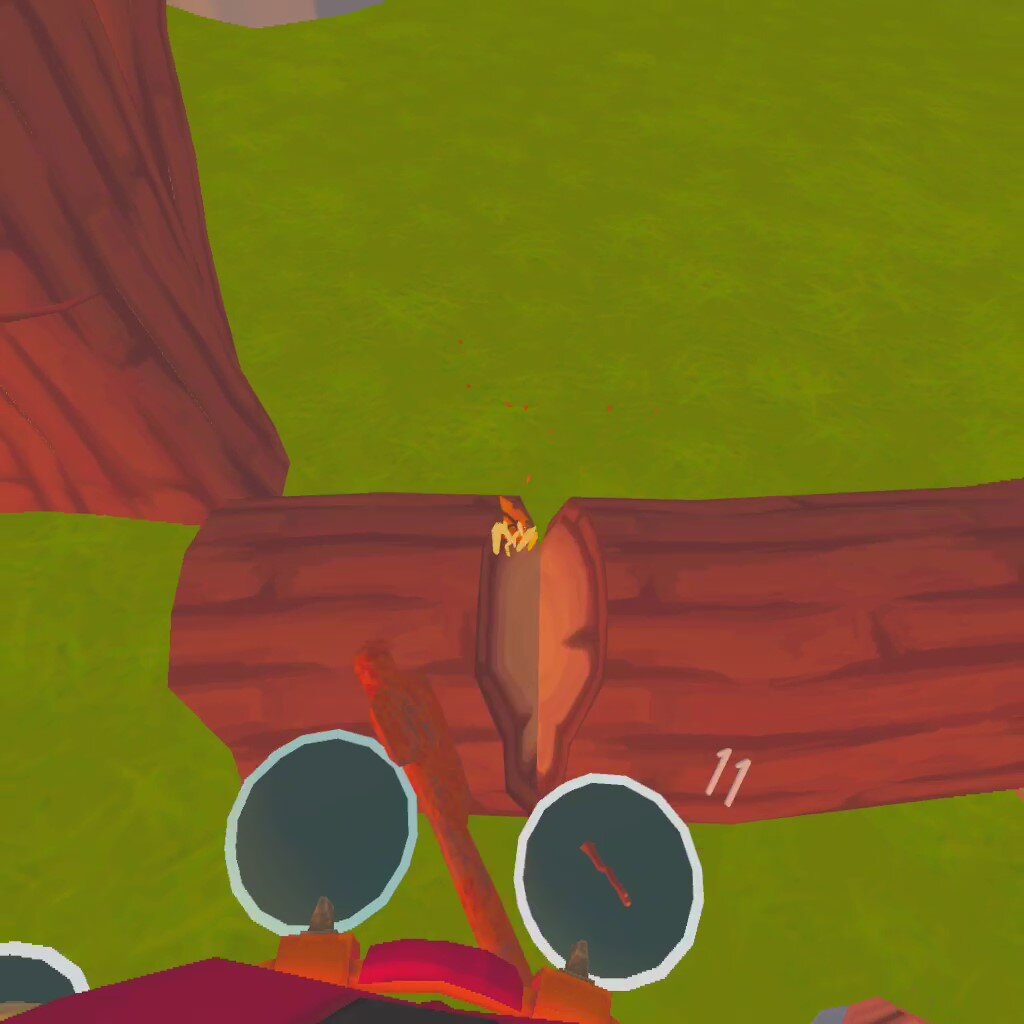
Mining gets a little more complicated. This time you need to make your own tools. A flint pickaxe and a torch. There are checklist items for both. Though one is for the Crafting checklist and the other is for the Mining checklist. This doesn’t make a lot of sense, as you will need the flint pickaxe to mine anything. The “Craft flint and stick together” item really belongs on the mining checklist. God help you if you start bashing a rock with another rock. That might not make sense in the real world, but this is still a video game. Maybe you’d think that would work. Nope, you need flint on a stick.

Grab your piece of flint and a stick, and helpfully a little trail of green magic will show you where you can put it to finish creating your little pickaxe. The same goes for a torch. That was easy enough as well. You go into the mines, bash a few stones into smaller stones. Boom, mining complete. Congratulations. Now comes the hard part, crafting.
Crafting Starts Hard
Crafting feels like a skill, something you would need to learn just like you would in real life. There a knack to smashing in nails just right. There’s an order to where the pieces go. Clearly knowledge of the game helps a lot in crafting, so crafting something for the first time without that knowledge is confusing and often frustrating. The backpack you must make in the tutorial island is a great example of this.

A nearby sign helpfully states that you only need grass and sticks to make this backpack. Luckily there are a lot of both just outside of the building. It also states that you will need to hammer in some nails. Hopefully you can figure out that nails are automatically added and that you need a rock to hammer them in. At first you just add pieces, sticks and grass. When you pick up the right piece, where it should go is highlighted, but you don’t know what order they go on it. A lot of trial and error ensues. Maybe you notice when a nail should be hammered in before you can add the next piece, maybe you spend ten minutes trying to add the next piece before noticing that you needed to hammer in a nail before going forward. Maybe you figure out that the sticks in the frame need to go in before the grass does. Well you either figure it out yourself, or you take off your VR headset and turn to the internet for someone to show you exactly how its done. Also, hammering is hard. Just like chopping wood, there’s a knack to getting it just right, and sometimes when you hit a nail it seems like it should go in further and it doesn’t.
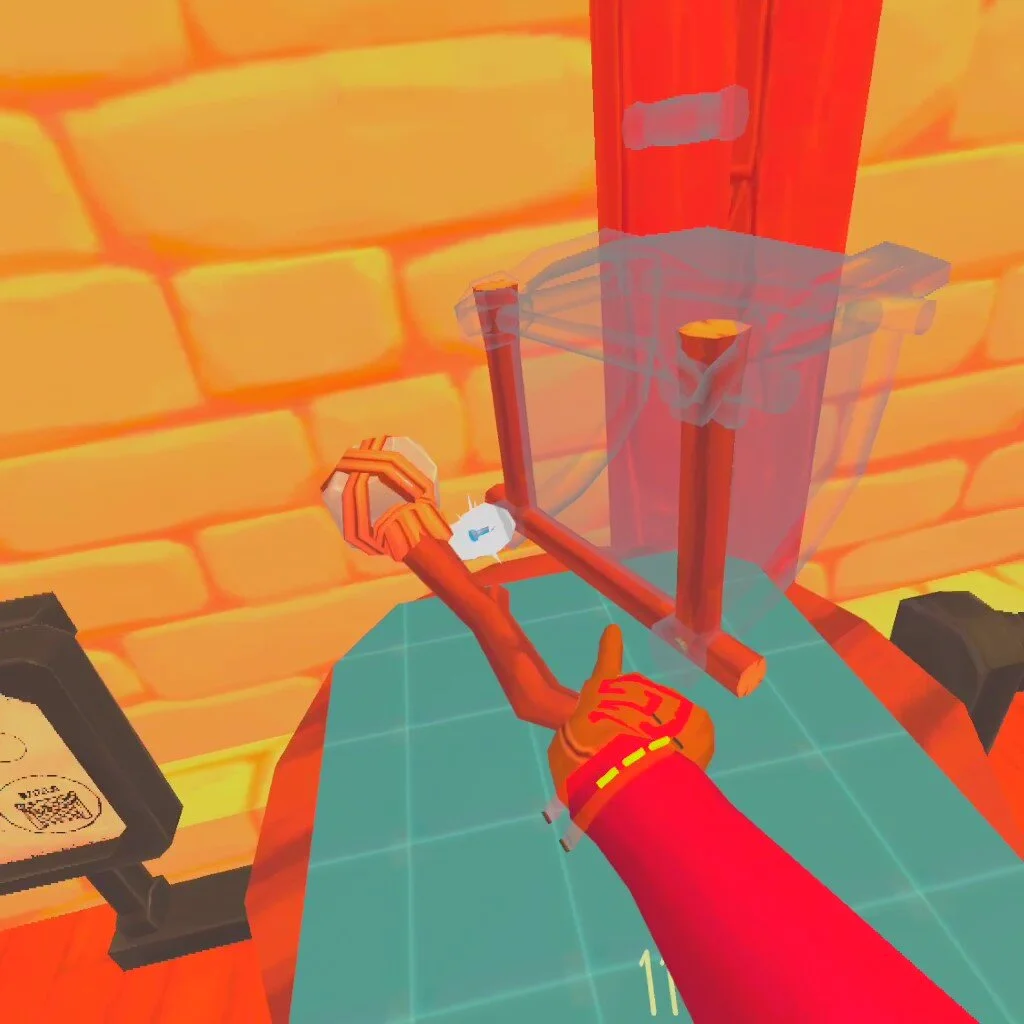
Getting caught on a single part that just doesn’t make sense is frustrating. There’s really nothing to turn to in game to help you figure it out. So you may just take your headset off and Youtube it, which is a failure of the game. Having to turn to Youtube to figure something out means that the tutorial is just insufficient. Not to mention, this backpack is the easy part. It’s the introduction. Maybe it’ll make sense to you, maybe you’ll be lucky enough to not run into a bug that makes this even harder. A nail that is required for the next section may not appear, or the place you need to put a part may not highlight. Sure A Township Tale still needs a lot of work put into it, but when you’re not sure what you should do next one of these bugs is a show stopper. Whenever you put the backpack together you’re ready for the open world, the true game.
Crafting Gets Harder
It’s going to feel like one long tutorial for a very long time. With so many more things to craft and do there’s a lot of figuring out ahead. Oh, and checklists, no tutorials, no how tos, just checklists.

Let’s take carpentry as an example. To make a lot of things you’re going to need wooden handles and other parts. They’re the base of a lot of useful items, like swords. The checklist seems simple. Add the ingredients to make a short wooden handle, 6 wood in this case. Select the recipe and add it to the bench, and then just chisel it out of the wood. In most games this would be sufficient. All accomplished in a few button presses. In A Township Tale, there’s a lot of details not handled in such a simple list. First of all there’s adding the wood to the bench. No, you don’t just place it on the bench.

You really need to place it between the two pincers on the let side of the bench, to hold them in place for chiseling later. Well nothing tells you that. You need to figure it out, and if you don’t you’re going to have to Youtube someone else doing it. See the trend? When you don’t get it naturally there’s nothing in game to help you out. Well there’s some arcane runes of some sort in the crafting recipe itself, helpfully sitting on a nearby pedestal, but good luck getting such minor, yet vital, details out of that.

So you’ve got the wood on the block, the next item is to add the recipe to the bench. Okay, there’s no obvious way to select a recipe. Maybe just placing the book on the bench will do something? No. Maybe putting the book in the slot on the side of the bench that seems to be just about the dimensions of the book will add it. No. What you need to do is rip a page of the recipe out of the book, and then put it in that little slot. You may have tried ripping the page out and just not ripped hard enough, because you weren’t sure that was the way to do it. So now the bit you need to chisel off first lights up. Okay, grab the nearby chisel and hammer, and whack at the back of the chisel like you would in real life. Intuitive. Oh, but make sure you whack it with a wide swing, and make sure the chisel is just about horizontal but not quite, or there will be absolutely no result.

There are so many places to get caught up the first time you do even the most basic recipe, and that is the crux of the problem. It is insanely easier and less frustrating to just stop playing the game and find a video of someone else doing the same thing, so you can get all of the minor details. Hopefully you don’t get bored or distracted on the way back to the game. There really should be something in game that tells you these gaps, the checklists provide some structure, but just aren’t sufficient.
Tutorials are a lot harder in VR, where the tasks are so physical and the guidance is more complicated than saying “press a button” or highlighting the button to press. A more elegant solution like a hologram that mimics what you need to do might be in order, but that is much harder to implement. Even more thorough text that tells you how to do these things would help. For instance, telling you that you need to rip out the crafting page instead of just saying “Add the Recipe to the Bench.” Games need an in game tutorial that doesn’t rely on exiting the game to watch a video in order to do basic crafting and tasks. Or do they?
In Conclusion
A Township Tale has a big emphasis on a community working together to achieve goals. Maybe the designers intended for players to rely on one another to teach them how to do these things. There’s definitely fun to be had there, and the joy in passing on skills earned to a junior player.
Crafting isn’t as simple as pushing a button, there is actual skill involved. The more you do it the better you get at it. Not by seeing a number go up, but by being physically more agile at performing the actions you need to perform to turn a chunks of wood into a useful handle, or raw meat and kindling into a fire and cooked meat. That is the magic of VR, but it also offers a big challenge to new players. Does this lack of proper in game tutorials make the barrier to entry high enough to discourage new players, or would it rather encourage them to seek help from others and build communities in the process? Feel free to comment below on what you think.
Anyone who wants to try out this in depth crafting system can buy A Township Tale on Oculus Quest for 9.99 or play for free on PCVR. The Oculus Quest Price tag does come with some cosmetic bonuses and in game currency. If you really want to get into the game fast, watch some tutorials on crafting before jumping in.
More to Come
Reality Remake isn’t done with A Township Tale yet. After figuring out the basics there is a lot more game to dig into. Join us at our server, named realityremake.com. More articles on this intriguing experience to come soon.
Sniper Elite VR Review
World War 2 Shooters are one of the most prolific in the genre. For good reason too. Democracy stood against Autocracy. Freedom against Facism. A conflict that now is completely black and white. Nazis are bad, and so whenever you shoot a Nazi the joy of a shot well completed and a kill well scored is twice as sweet.
That is why it has been such a mystery that it has taken so long for a World War 2 Shooter like Sniper Elite: VR to appear on the Oculus Quest store. We’ve got a few modern shooters such as Contractors(Link), which features an okay WW2 multiplayer mode, and Onward(Link). Until now there has been no game completely set in and dedicated to this most classic of first person shooter subgenres. Of course now there is, and boy does VR, as always, put the “First” in First Person.

Preamble
World War 2 Shooters are one of the most prolific in the genre. For good reason too. Democracy stood against Autocracy. Freedom against Facism. A conflict that now is completely black and white. Nazis are bad, and so whenever you shoot a Nazi the joy of a shot well completed and a kill well scored is twice as sweet.
That is why it has been such a mystery that it has taken so long for a World War 2 Shooter like Sniper Elite: VR to appear on the Oculus Quest store. We’ve got a few modern shooters such as Contractors, which features an okay WW2 multiplayer mode, and Onward. Until now there has been no game completely set in and dedicated to this most classic of first person shooter subgenres. Of course now there is, and boy does VR, as always, put the “First” in First Person.
Sure, there’s the Medal of Honor: Above and Beyond too, but unless you’ve got a really good 5GHz router setup or want to chain your headset to an expensive computer, Sniper Elite:VR is what you’ve got now.

The Setup
You’re an old Italian man, an ex-Partisan. The frame for the story of the game is sitting at your father’s house, now yours, reminiscing on how hard you fought in the 1940s for the peace you now have in the 1980s. The player character’s voice is sweet and mellow with a charming accent. Get used to it, you’re going to hear it a lot.
In typical in medias res style, you are thrust into the first mission. You’re told how to pick up a rifle, how to load and chamber it. Shoot some targets though you’re supposedly in the middle of an active Partisan v. occupying Fascist force battle, and then go to the castle walls to get comfortable sniping the Wehrmacht. The controls are not the best, and sometimes you have to move your controllers uncomfortably close together to load or unload some weapons, like the first pistol you unlock, but time will get you used to them.

Between the missions you are brought back to the 1980s, watch your kids and grandkids play on a nice day, and go through your book of memories to access other missions. There’s more narration here as well. You’ll hear some every time to go back to the 1980s. Get used to it.

It’s a decent setup. There’s little emphasis on the actual strategy and goings-on of the war, though enough to provide some background. Mostly it’s just a series of scenarios with you, your weapons, and a lot of staring down scopes and popping the skulls off of the Wehrmacht. As mentioned, the narrator is talking almost constantly through all of this. Not even Morgan Freeman could pull off so much narration without getting a little annoying over time, but it’s not so bad.
The Controls
Controls are a huge sticking point in any VR title. Too floaty and it takes you out of the experience, too tight and you feel as though your arms are covered in molasses. Sniper Elite: VR definitely trends on the floaty side. Objects you hold, mostly weapons, don’t feel as if they have any weight when you move your hands. The slightest tremor can completely ruin your perfectly sighted shot. For a game as focused on precision shooting and sniping as Sniper Elite: VR this is often a problem. Sometimes even grabbing objects from the environment does not feel as responsive as it should. Future patches may fix this, but at the time of writing Sniper Elite: VR is barely passable in this respect.
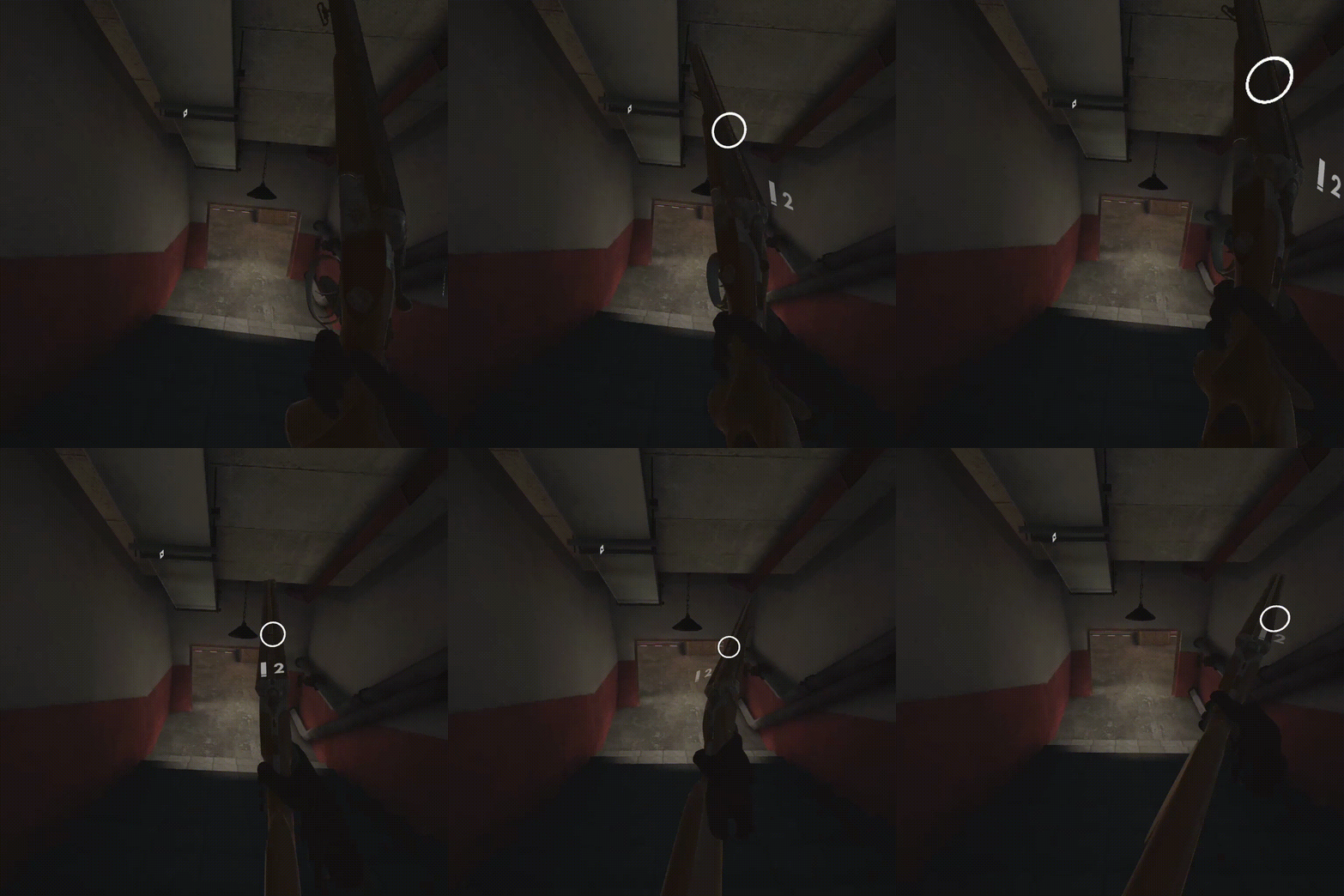
There’s also some glitches with loading weapons as well. Often you need to pull a pin out of a grenade twice before it arms. These sorts of issues happen a lot with newly released VR titles, and when the patches come hopefully they will be fixed. Warhammer 40,000: Battle Sister also had a lot of issues like this at launch, and now they are almost nonexistent.
If you’re not good at sniper rifles in VR, well now’s your chance to practice. As the name implies the use of sniper rifles is heavily encouraged by the mechanics of Sniper Elite: VR. You’re often placed far away from enemies and are always outnumbered, so anything with a scope and large caliber is naturally the best option. Also there’s uh… well there’s the kill cam. Let’s talk about the kill cam.
The Kill Cam
When Sniper Elite came out as a PC title, one of it’s greatest back-of-the-box selling points was the kill cam. For those that don’t want to just see the Fascist soldier simply fall back, lifeless, after a good shot, but want to see their organs burst and the high speed bullet rip the life out of them with x-ray vision. Sniper Elite is all about how precise and well-aimed your shots are, after all.

This doesn’t port so well to VR, a medium all about total immersion into a new space. It’s a very weird feeling to suddenly be ripped off of your battlement or tower or sniper’s nest. It feels as though you are thrust, physically, in front of the soon to be dead opponent to watch their skull shatter and eyeballs turn into mist. Then you’re back to your post, as the player character once more. It’s jarring, it’s a bad idea for VR, and it’s a bit much. Especially since it triggers very often, even on the minimal setting. Luckily it can be turned off completely.
The Arsenal
Oh, but there is still a lot of fun to be had. VR Singleplayer titles tend to lack a large variety of weaponry, well not in Sniper Elite:VR. Over the course of the game you can use every conceivable weapon that could be found in Italy at the time. From Panzerfausts to M1911 Pistols. There is a wide array of not only sniper rifles, but sub machine guns, pistols, shotguns, and even high explosives to put to use against the forces of the Wehrmacht. Though you’ll be using the sniper rifles most of all.
Your player character can carry a large amount of artillery on them at any given moment, all on a fairly well implemented, though sometimes frustrating set of body points for storage. Two on the back for the big guns. Two for grenades, two for pistols, and two pistols or explosives. You could carry four pistols if you want to be a real desperado.

The various methods of loading, chambering, aiming, and firing each of these weapons is intuitive and highly varied. They are introduced at a good pace to keep things interesting. After you discover a weapon your favorites can be put into one of three loadouts to use your missions ahead. Though you’ll be using the sniper rifles more than anything else. There’s not much difference between those, though there are a lot of them. Sometimes it feels that the variety of weapons is a little wasted, but boy they are still fun.

Your enemies also vary their weapons, though not as much as you. You wouldn’t see a Nazi sniper using a Russian Mosin-Nagant after all, or a Fascist shocktrooper using a British Sten gun. They use german weapons, though their ammunition is compatible for the same weapon type. Over the course of the game you will see more and more elite enemies, which can absorb multiple shots before they are killed. Unless you aim for the face of course, the face is always the best place.
Pretty standard stuff, though what’s more interesting is their AI. Rather, what's more interesting is how uninteresting their AI is. Nazi troopers will generally spawn in, run to a predefined point, and shoot at you from the same spot. Maybe they’ll move around a little bit, or patrol the same path over and over. They’re not very smart, but there’s a lot of them.

Also, you are fragile, and the Nazis are pretty accurate at short range. Getting close to the Fascist Occupiers is hazardous to your health. You can die very quickly from a couple of bursts of an SMG. So you must take cover, which is fantastic in VR. No other type of game feels better to take cover in, physically crouching behind a wall, listening to bullets chip the rock as you steady your hands for the next time you pop out and take a shot. Sniper Elite: VR does this well, and it helps with its reliance on ranged combat.
Though if you would rather be throwing grenades and clearing trenches run and gun style, this game may not have enough of that for you. Like it says in the title, Sniper Elite: VR wants you to spend most of your time well… sniping.
Precision is Key
Some enemies can survive a sniper round to the body, head, legs, arms, but not the face. The face is where the points are, and where the satisfying instant kills are. Especially satisfying if you like the kill cam a lot. Sniper Elite: VR helpfully provides you the ability to “focus” your shots. Doing so gives you a little more zoom to your scope or iron sights, and highlights where you will hit. Also it slows down time, giving you plenty of time to line up the perfect kill. If you take your time, it’s pretty satisfying.

You get points for shooting certain organs or body parts, lungs, brains, et cetera. You get points for blowing up enemies. You get more points for killing enemies from stealth. If you like to see a nicer playthrough give you a bigger number, Sniper Elite: VR has that for you. There are also collectables hidden throughout the maps as well for any treasure hunters, and challenges to complete for every mission. Usually they are something like “Get so many points” or “Get X kills with X weapon.” Make sure you complete these, as a certain amount of objectives are needed to progress to later missions. Also there’s an experience bar for each weapon, though they don’t get you anything for filling it. Maybe if you collect all of them you’ll get… a golden gun? Please leave a comment if you’ve filled all of them.
While not as satisfying as getting a perfect playthrough on a game like Hitman, dispatching enemies in the most quiet and efficient way is definitely a form of satisfaction to be had here. The numbers will tell you how well you did so.
You can go back to previously completed missions at any time, so if you feel the need to perfect your playthrough, go nuts.
Stealth
Stealth is optional in Sniper Elite: VR, and that’s a good thing. Enemies spot you from very far away, which makes sense. You rarely have a chance to get into melee range. You’re meant to shoot them from afar with the silenced single shot pistol or sniper rifle. Unless you’re using the silenced rifle, found much later in the game. To shoot a Nazi guard stealthily with most sniper rifles you will need to wait for something to mask the sound of the shot. So you always know when you’re in a “stealth” section of the game, because some loud sound will constantly fill the top part of your screen with “Sound Masked”. If the “Sound Masked” icon is at the top of your screen, your gunshot can still be heard if the sound is not loud enough. You need to shoot at the very apex of the noise.

Other than not being heard, you also need to avoid being seen. This system is a little frustrating in VR, as you need to press the crouch button, rather than physically crouch, to enter stealth mode. Leave a comment if you’ve found a way around this, but physically crouching offers no stealth benefits. There is no hybrid method like in The Walking Dead: Saints and Sinners, which allows you to physically crouch or press the button if you prefer to take it easy on your knees. Pressing the crouch button makes avoiding detection a lot easier. It’s also immersion breaking if you don’t prefer to use it.

The guards either seem to be completely oblivious or able to spot you from miles away. In general the stealth is alright, and not strictly necessary. If you’re looking for a Thief: Deadly Shadows VR this is not quite the game you’re looking for, but there’s some good sneaky gameplay to be had in some missions.
To Conclude/TLDR
The VR aspect of Sniper Elite: VR is not very new or revolutionary. Though for the Quest, which is starved for even decent Singleplayer shooters, it is a good addition. The mechanics are all about shooting accurately and carefully from range, though the VR physics are subpar and make this a bit more difficult than it needs to be. There are bugs, but only enough to annoy and frustrate occasionally.
If you like World War 2 Shooters, definitely get this game. There’s plenty of good Nazi killing to be had here. Shooting Nazis always makes for feel-good fun.
